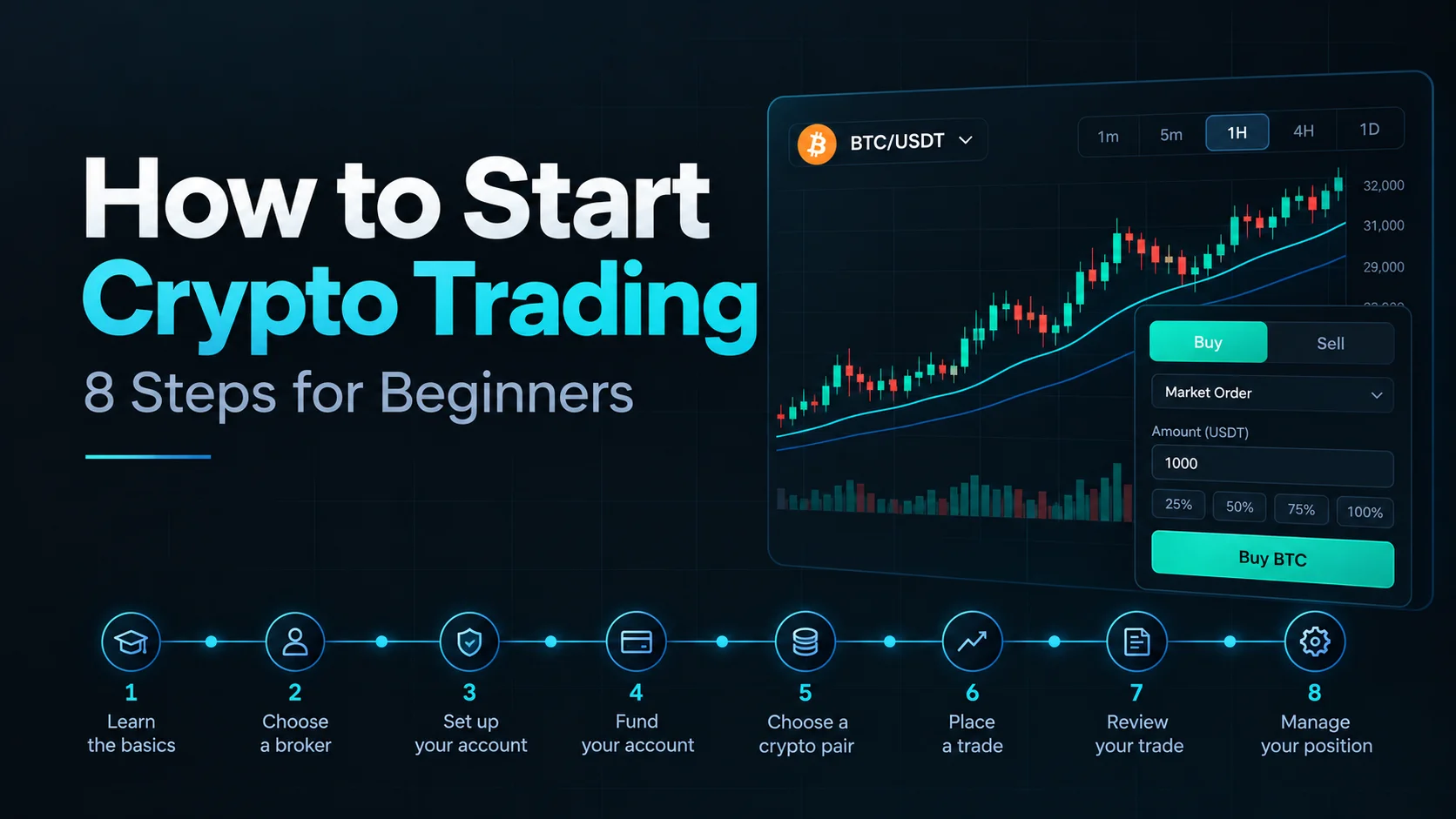
To start trading cryptocurrency, learn how spot trading works, choose an exchange available in your country, secure your account, understand the full cost of a trade, and select a trading pair. Then place a small market or limit order, check the confirmation, and decide in advance when you would sell. The process is straightforward to learn, but profitable trading is not: cryptocurrency prices can move sharply, and you can lose your entire investment.
Start here: If you have never traded before, practice with hypothetical orders first. When you are ready to use real money, begin with an amount you can afford to lose and avoid leverage.
Risk warning: Cryptoassets can lose most or all of their value. Leverage, thin liquidity, fraud, and custody failures increase the risk of substantial losses. This material is educational and does not constitute personalized investment, tax, or legal advice.
What Is Cryptocurrency Trading?
Cryptocurrency trading is buying and selling digital assets, such as Bitcoin or Ether, in response to changes in their market prices. In a spot trade, you buy or sell the cryptocurrency itself at current or specified market prices. A trading exchange can hold the purchased asset on your behalf, or you may be able to withdraw it to a wallet that you control.
Trading is different from investing. A trader generally plans entries and exits over a defined period, from hours to months. A long-term investor may hold an asset for years despite short-term fluctuations. Neither approach guarantees a positive return.
It is also important to distinguish spot trading from crypto derivatives, such as futures and contracts for difference (CFDs). Derivatives provide exposure to price movements without necessarily giving you ownership of the cryptocurrency. Some allow leverage, which can magnify losses and cause rapid liquidation. This beginner's guide focuses on unleveraged spot trading.
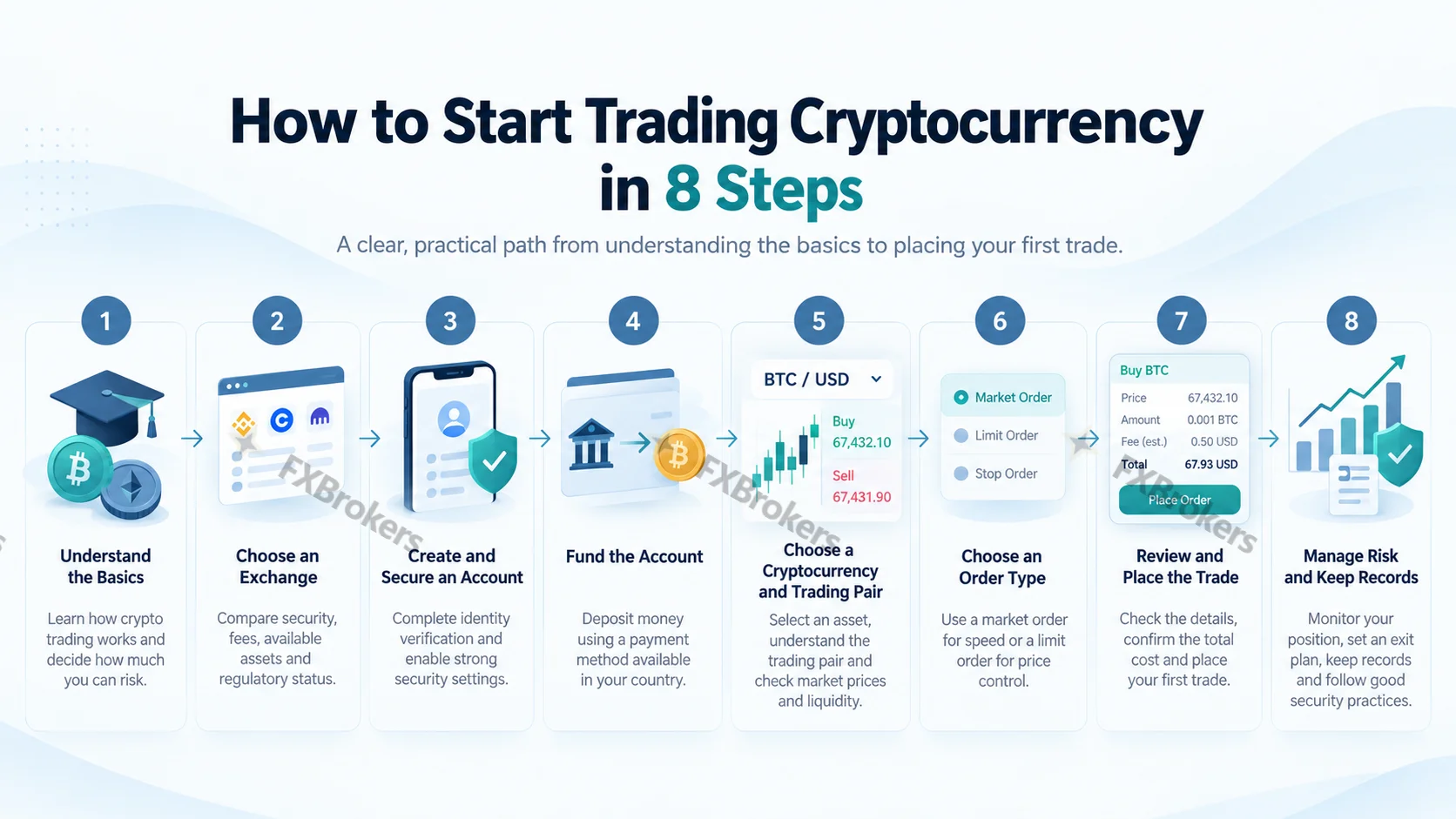
How to Start Trading Cryptocurrency in 8 Steps
You do not need to understand every aspect of blockchain technology before learning the trading process. You do need to know what you are buying, what it costs, how to place an order, and how the trade could go wrong.
Learn the basics and set a risk budget
Begin with four concepts: the asset you want to trade, its quoted market price, the order you will use, and the amount you can lose. Cryptocurrency markets can move rapidly, sometimes even when traditional financial markets are closed. A profitable trade is never assured merely because an asset has risen before.
Separate money for essential expenses, bills, savings, and emergencies from money intended for speculative trading. Your trading budget should be small enough that a total loss would not affect your ability to meet financial obligations. Borrowing money to trade adds another layer of risk.
Before placing an order, write down why you would enter, what change would make you exit, and how much you are prepared to lose. If you cannot explain those decisions, use a paper-trading journal to practice without spending money.
Beginner check: Can you describe, in one sentence, what would make this trade a mistake? If not, keep learning before committing funds.
Choose an exchange available in your country
A cryptocurrency exchange provides a marketplace or service for buying and selling digital assets. Coinbase, Kraken, Binance, and Crypto.com are examples of widely known platform names, not an independently ranked list of the best exchanges. Their services, eligible users, fees, and available products differ by country and sometimes by state.
Evaluate a platform using practical criteria rather than promotional offers:
- Legal availability: Does the platform explicitly serve your country or state, and can it offer the specific product you intend to use?
- Registration and oversight: What permissions or registrations apply to its activities? Registration does not automatically mean that deposits or crypto holdings are government-insured.
- Total trading costs: Check quoted buy and sell prices, trading fees, spreads, funding charges, and withdrawal costs.
- Liquidity: Are there enough buyers and sellers for ordinary trades in the asset you want?
- Security and access: Look for strong account authentication, withdrawal controls, transparent support, and a reliable way to retrieve your transaction history.
- Custody and withdrawals: Can you transfer the asset to your own wallet if you choose, and are there limits, holds, or supported-network restrictions?
Compare the actual order preview on more than one platform when possible. An exchange advertising a low trading fee may still have an unfavorable spread or a costly funding method.
Create, verify, and secure your account
Open an account through the platform's verified website or official app. Depending on where you live and which service you use, identity verification may require your legal name, address, date of birth, and identification documents. Do not try to bypass location or identity restrictions.
Protect the account before depositing money. Use a unique password and a passkey or strong multifactor authentication where available. Protect the email account connected to the exchange as carefully as the exchange account itself. Turn on withdrawal notifications and account activity alerts if offered.
Be wary of sponsored search results, look-alike websites, unsolicited messages, and people offering to set up an account for you. Legitimate support teams should not need your password, authentication codes, or wallet recovery phrase. A recovery phrase gives access to a self-custody wallet: anyone who obtains it may be able to take the funds.
Beginner check: Confirm the account security settings and withdrawal process before transferring a significant balance.
Deposit a small amount and check the costs
Most platforms that support purchases with traditional currency offer one or more funding methods, such as bank transfers or payment cards. Available methods and charges vary. Some deposits may be delayed, restricted, or subject to a withdrawal hold.
Review the full price of getting money into and out of the platform. You may encounter a card processing charge, conversion charge, trading commission, or difference between the displayed market price and the exchange's quoted purchase price. Crypto withdrawals can also involve platform and blockchain network fees.
Do not assume that depositing $100 means you can purchase exactly $100 of cryptocurrency and still have enough to pay every fee. Check whether fees are included in the quoted amount or charged separately. Confirm minimum order sizes before sending funds.
Beginner check: Know the amount you will spend in your local currency, the amount of crypto you expect to receive, and whether you will pay again to sell or withdraw it.
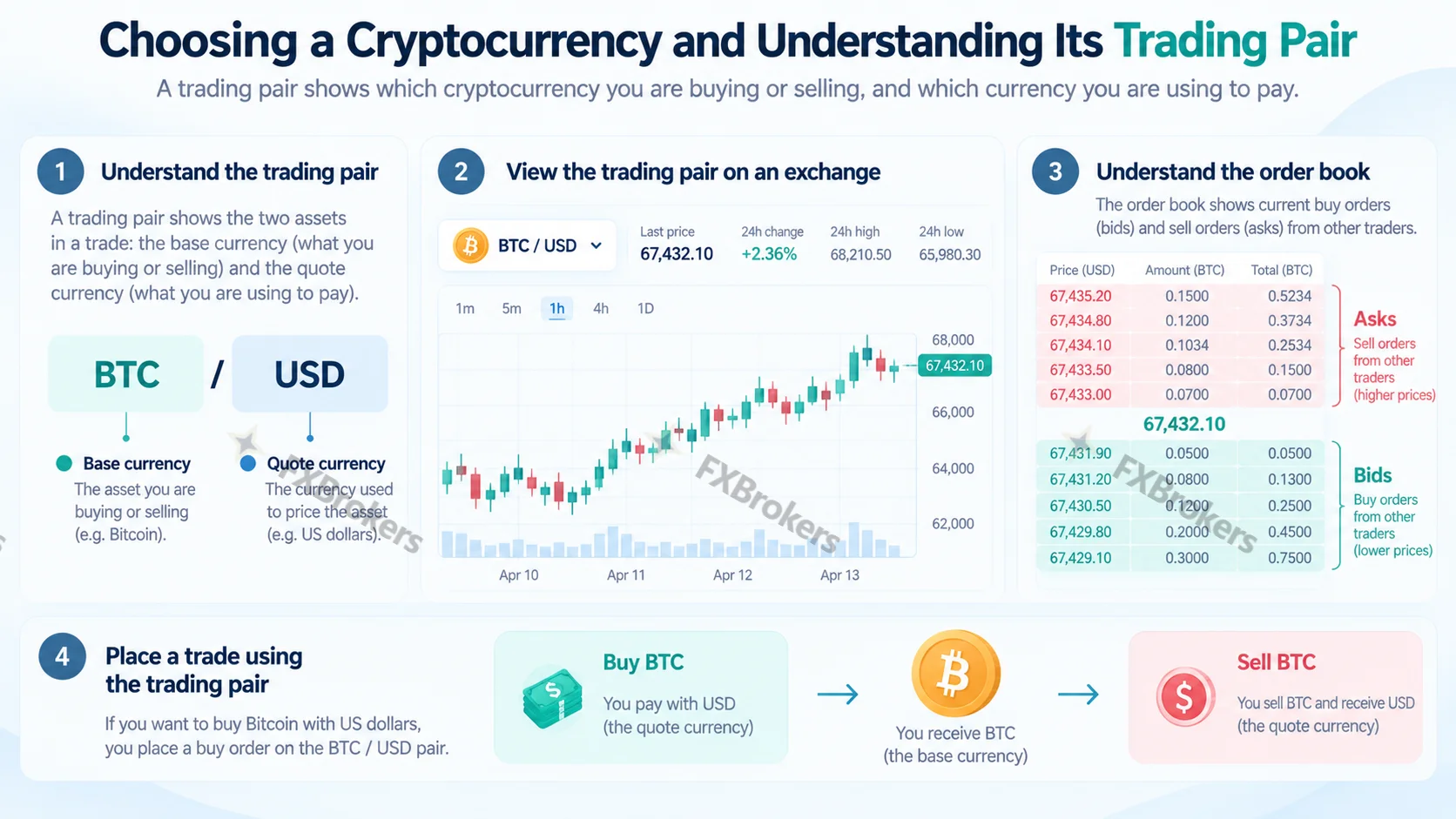
Choose a cryptocurrency and understand its trading pair
Start by understanding one asset rather than scrolling through hundreds of coins. Look at how it is used, how its supply works, its trading activity, and any meaningful project or custody risks. Large, actively traded assets may have deeper markets than obscure tokens, but their prices can still fall sharply. A popular name or a high market capitalization is not a safety guarantee.
Cryptocurrencies trade in pairs. For example, BTC/USD quotes the price of one Bitcoin in US dollars. BTC is the base asset and USD is the quote currency. If BTC/USD were hypothetically priced at $50,000, a $100 purchase before fees would correspond to 0.002 BTC. You generally do not need to buy a whole Bitcoin.
When you inspect a pair, you may see two prices: the bid, which is what a buyer is offering, and the ask, which is what a seller is requesting. The gap between them is the bid-ask spread. The order book shows available buy and sell interest at different prices; thin markets can produce larger price differences when orders execute.
Avoid choosing a coin solely because it is trending on social media, promoted by an influencer, or claimed to be the next major opportunity.
Choose a market or limit order
When you are ready to buy, an exchange will typically ask for an order type and amount. The two most useful order types to learn first are:
- Market order: Seeks to execute promptly against available orders. It prioritizes execution, but the final price can differ from the last price displayed, especially during volatility or in a thin market.
- Limit order: Sets the highest price you will pay to buy, or the lowest price you will accept to sell. It may execute at that price or a better one, but it can remain open or never fill.
For example, if an asset is trading around $100, a buy limit order at $98 will not ordinarily execute above $98; the market must offer sufficient sell liquidity at $98 or less for a fill. A market order, by contrast, may fill quickly at available prices rather than exactly $100.
Some exchanges offer stop-market and stop-limit orders as well. These can help implement an exit plan, but they do not guarantee the exact exit price or even execution in every case. Learn the exchange's specific trigger and order rules before using them.
Review the order ticket and place your first spot trade
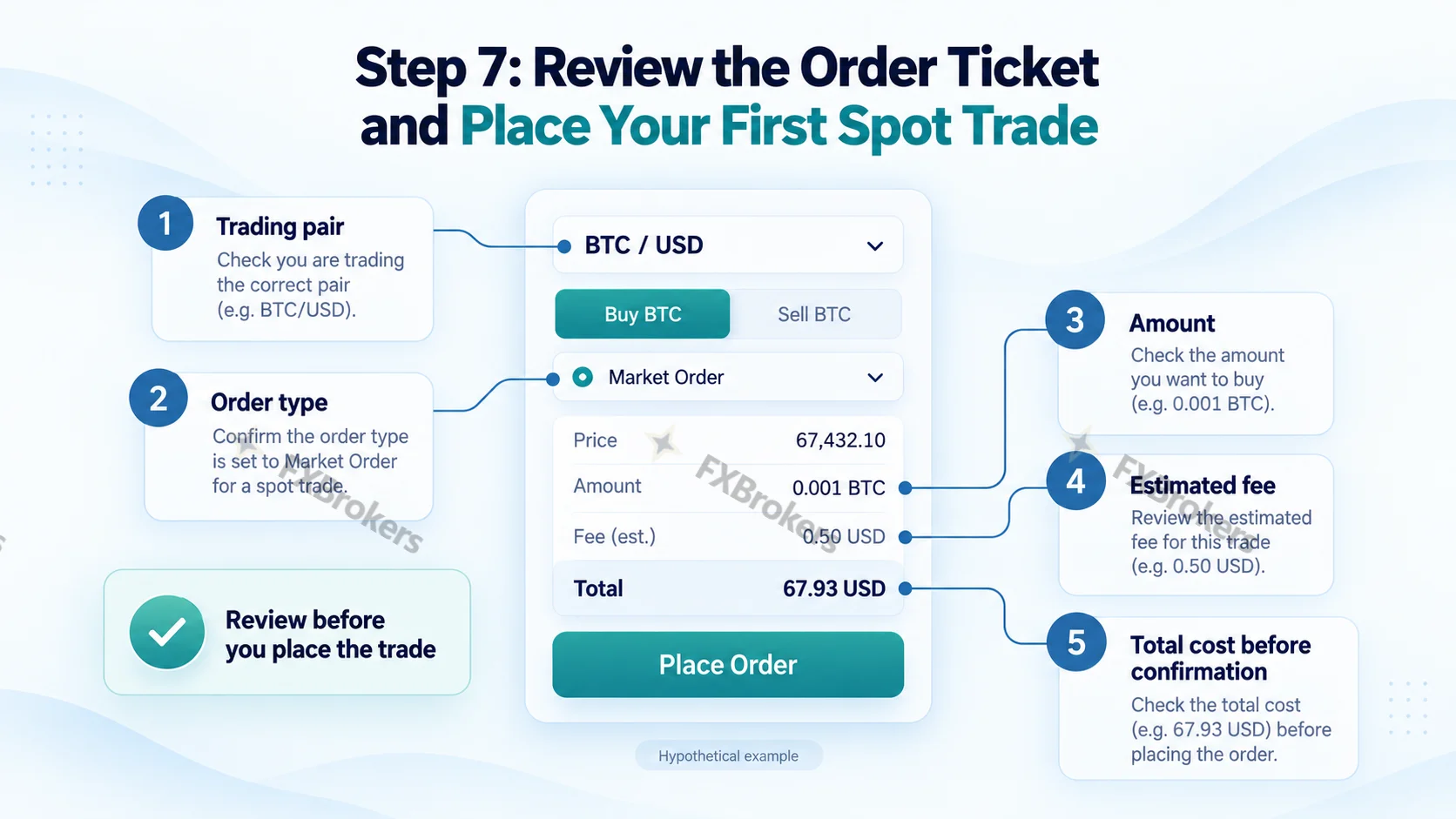
A first trade should be deliberately simple: one spot asset, a small amount, and an order type you understand. Before selecting Buy, review the complete order preview rather than relying on the chart alone.
Order field Example What to verify Market BTC/USD Correct asset and quote currency Product Spot Not a leveraged or derivative product Side Buy You are opening a purchase, not a sale Order type Market Price may change before execution Asset amount $100 notional Minimum order and estimated crypto quantity Estimated fee $0.50, hypothetical Actual exchange fee and any additional charges Estimated cash needed $100.50 Whether fees are added or deducted Illustrative order-ticket checklist — not a live market quote After submitting the order, check its status. It might be filled, partially filled, open, canceled, or rejected. A pending limit order is not the same as an executed trade. Once it fills, record the execution price, quantity, fees, time, and transaction identifier. The exchange's confirmation—not the price you hoped for—is the record of what happened.
Beginner check: Never repeatedly press Buy because the screen seems slow. Check order history first to avoid accidentally entering twice.
Manage the position, custody, and your trading records
Buying is only half of a trade. Decide what would justify selling, how much loss you are prepared to accept, and how you would act if the price moves sharply. Review the position according to that plan instead of checking every price movement or reacting to online predictions.
Decide where the asset will be held. Keeping crypto on an exchange is convenient for active trading, but it creates dependence on the platform's controls and solvency. Moving assets to a self-custody wallet gives you control of the wallet credentials while making you responsible for protecting them. Sending crypto to the wrong address or unsupported network can result in irreversible loss.
Keep a trade log with the asset, quantity, entry and exit prices, dates, fees, reason for the trade, and result. Save the platform's statements or export files. These records also help when reviewing performance and preparing taxes.
Beginner check: Know how to sell, transfer, and export records before increasing your position size.
Can You Start Crypto Trading With $100? A Realistic Example
Yes, $100 can be enough to learn how a small spot trade works on a platform with a suitable minimum order. It is not enough to create a reliable daily income, and costs matter more when the trade is small.
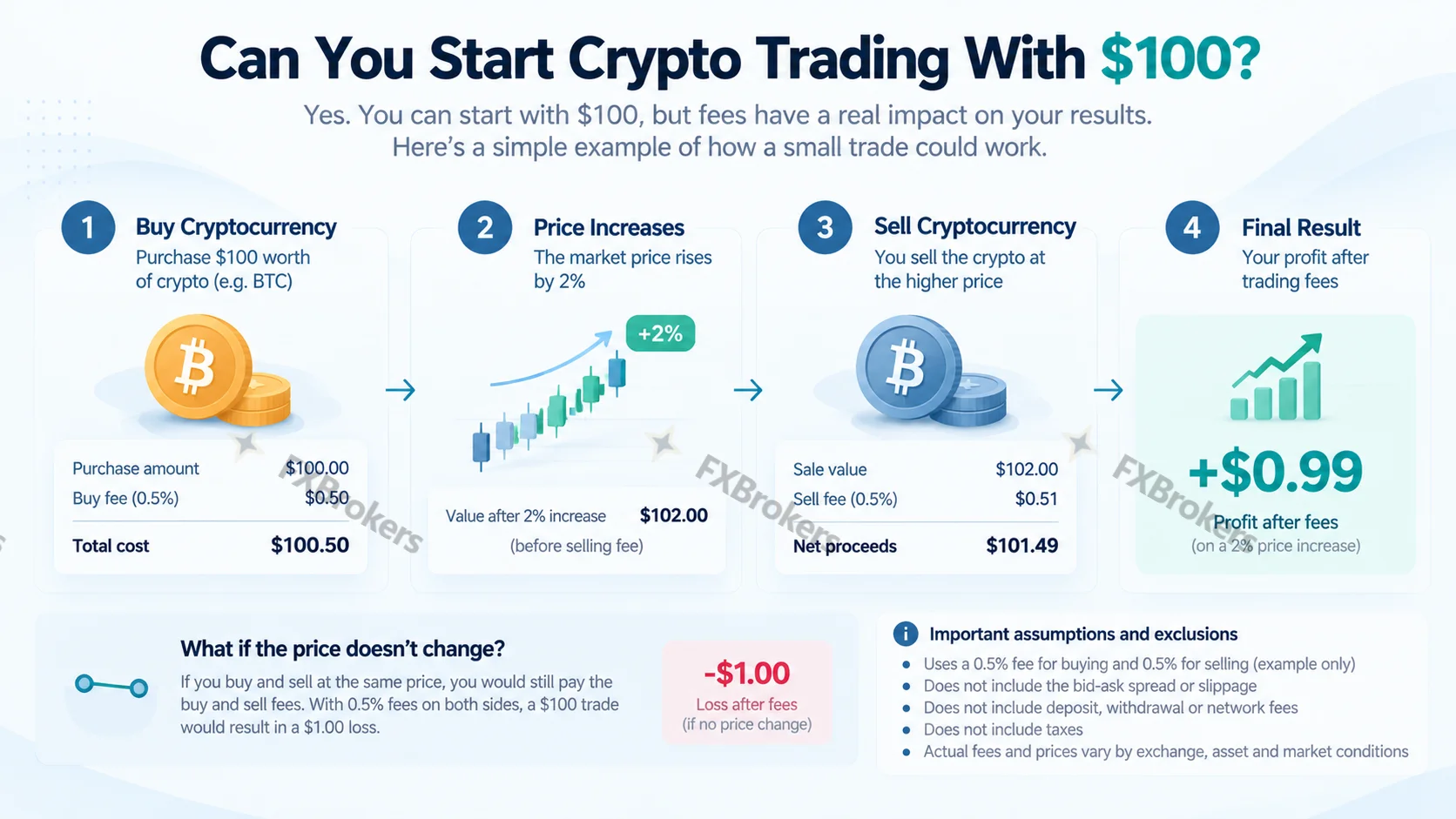
Suppose you purchase $100 worth of cryptocurrency before fees. For this example only, assume a 0.5% fee when buying and another 0.5% when selling. These are illustrative rates, not the published fees of any particular exchange. Because the buying fee is charged on top, this example requires $100.50 in available funds. If you have exactly $100 to spend, you would need to reduce the amount purchased to leave room for the fee.
| Calculation | Amount |
|---|---|
| Cryptocurrency purchased, before fees | $100.00 |
| Buying fee: 0.5% of $100 | $0.50 |
| Total initial cash outlay | $100.50 |
| Value after a hypothetical 2% rise | $102.00 |
| Selling fee: 0.5% of $102 | -$0.51 |
| Cash received after selling | $101.49 |
| Net trading profit before other costs and tax | $0.99 |
The asset increased by 2%, but the trader made only $0.99 because the fees applied on both sides. If the market price had not changed, selling the same position would return $99.50 after the illustrative selling fee, creating a $1.00 round-trip loss compared with the $100.50 initial cash outlay. A price decline would increase that loss.
This example excludes the bid-ask spread, slippage, funding charges, withdrawal or network fees, currency conversion, and tax. Real exchanges may deduct fees differently, charge minimum fees, or use variable pricing. Always rely on the actual preview shown before committing a trade.
Crypto Order Types Explained: Market vs. Limit vs. Stop
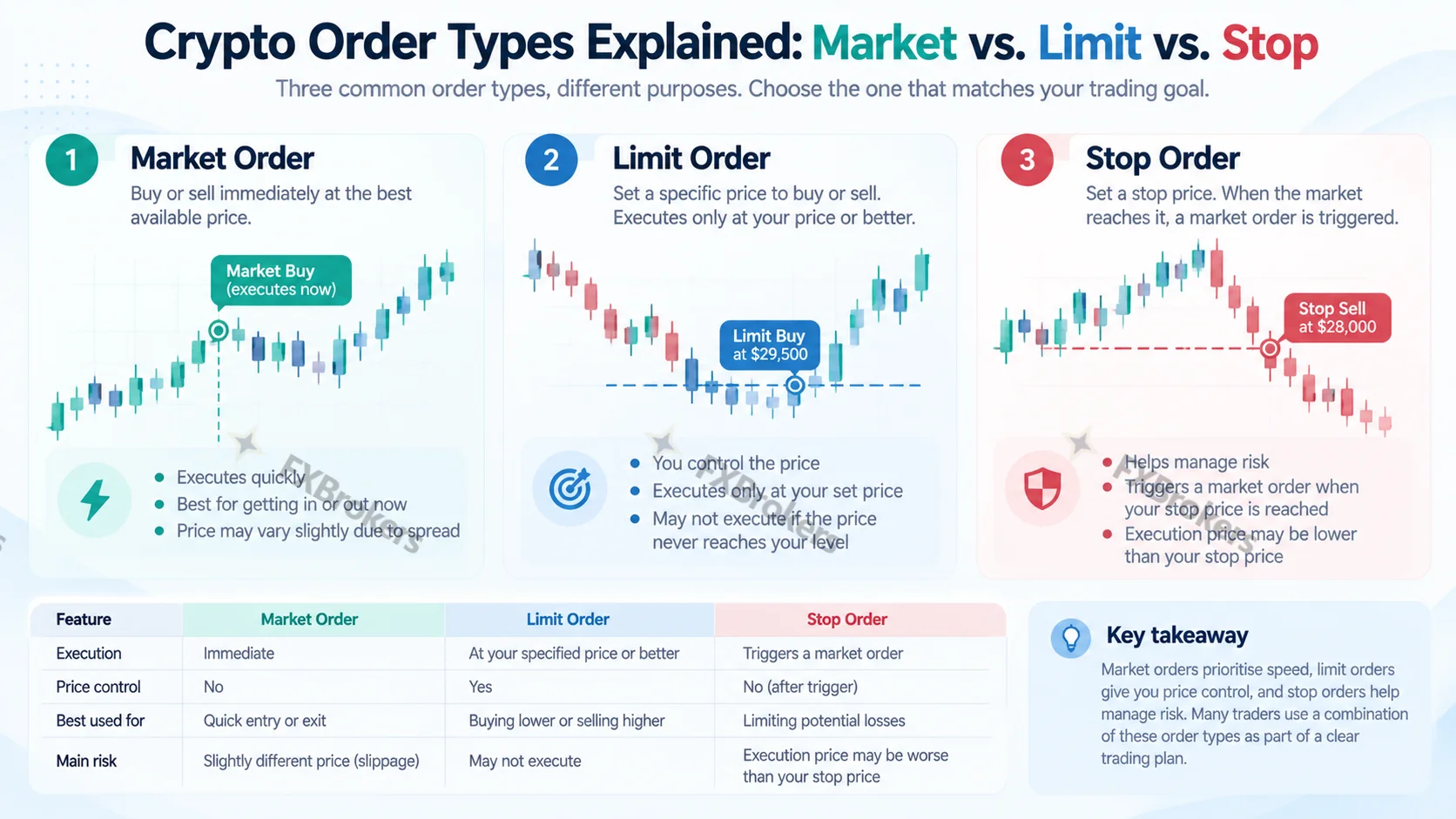
An order type determines how your instructions enter the market. The correct choice depends on whether immediate execution or price control matters more—and neither choice removes trading risk.
| Order type | What it does | Main limitation |
|---|---|---|
| Market | Attempts to trade promptly at prices currently available. | The execution price can slip from the displayed quote. |
| Limit | Specifies a maximum buy price or minimum sell price. | The order may be partially filled or never executed. |
| Stop-market | Typically submits a market order after a trigger is reached. | A trigger does not guarantee the eventual execution price. |
| Stop-limit | Typically submits a limit order after a trigger is reached. | It may not fill if the market moves past the limit price. |
Order labels and trigger mechanics vary by platform. A limit order can also execute immediately if its price crosses the available market; it does not automatically qualify for a lower maker fee. Understand how your chosen venue handles partial fills, open orders, cancelation, and trading fees.
How Much Money Do You Need to Start Trading Crypto?
There is no universal minimum deposit or minimum trade size for cryptocurrency trading. Some platforms allow small fractional purchases, but eligible payment methods, order minimums, and trading fees differ. The useful starting amount is one that lets you learn the process without putting necessary money at risk.
Can you start with $1? Sometimes, but not on every exchange or in every trading pair. Even where a $1 purchase is allowed, fixed fees, spreads, or a minimum order size may make it impractical.
Can you start with $100? Often, yes, for a modest spot order. Just distinguish your total cash budget from the amount of crypto purchased: a $100 trade plus an extra fee requires more than $100 if the fee is charged separately. The example above shows why a rising price does not necessarily produce a meaningful profit after costs. A $100 account should be viewed as a learning budget—not as capital from which to expect a particular daily income.
For complete beginners, the best first investment may be time rather than money: practice reading quotes, calculate hypothetical fees, and track simulated entries and exits before moving to live trades.
Which Cryptocurrency Trading Strategy Should Beginners Learn First?
The first strategy to learn is not a chart pattern. It is a repeatable trading plan: what you trade, why you enter, how large the position is, what would make you exit, and how you evaluate the result.
Start with a written plan and simulated trades
Choose one liquid pair and write down a proposed entry, exit, maximum acceptable loss, and estimated transaction cost. Record several hypothetical trades and review your decisions. Paper trading cannot reproduce every emotion or live execution condition, but it helps you learn without risking capital.
Understand the differences between common approaches
- Buy and hold: An investment approach in which an asset is held for a longer period. It still exposes the holder to large price declines.
- Dollar-cost averaging (DCA): Investing a fixed amount on a schedule rather than trying to select each entry price. It is a purchasing approach, not a guaranteed loss-prevention method or a short-term trading system.
- Swing trading: Holding positions for days or weeks to act on a planned market movement. It requires a reasoned entry, exit, and risk plan.
- Day trading: Opening and closing positions within the same day. Frequent trading, fast decisions, and transaction costs make it a demanding starting point.
Size positions according to risk, not excitement
Some traders use a guideline such as risking no more than 1% of their account on a planned trade. For a $500 account, that means a planned loss budget of $5—not necessarily a $5 position. This is a heuristic, not a guarantee: price gaps, slippage, fees, and failed order execution can make realized losses larger than planned. You can choose to risk less or not trade at all.
Leverage and perpetual futures are not necessary for learning spot trading. They introduce financing, liquidation, and other complications that can overwhelm an inexperienced trader.
Crypto Trading Fees, Risks, and Mistakes to Avoid
A good beginner guide must explain losses as clearly as potential gains. Even a correctly placed trade can lose money because the market moves against you, costs reduce the result, or an exchange or wallet fails.
Understand every fee before you trade
Trading fees may be expressed as a percentage of the order, a flat amount, or a price that already includes a spread. Some platforms distinguish between maker orders, which add liquidity to an order book, and taker orders, which remove available liquidity. Whether an order counts as maker or taker depends on how it executes, not simply whether it is labeled a limit order.
Consider the complete round trip: the funding method, purchase price, buy fee, bid-ask spread, sale price, sell fee, and any conversion or withdrawal charges. An advertised low commission is not the same as a low all-in cost.
Take security and custody seriously
Crypto transactions can be difficult or impossible to reverse. Avoid sending funds to wallet addresses provided by strangers, and verify the destination address and blockchain network carefully. When moving funds for the first time, a small test transfer may help detect errors, although it still incurs fees and does not eliminate every risk.
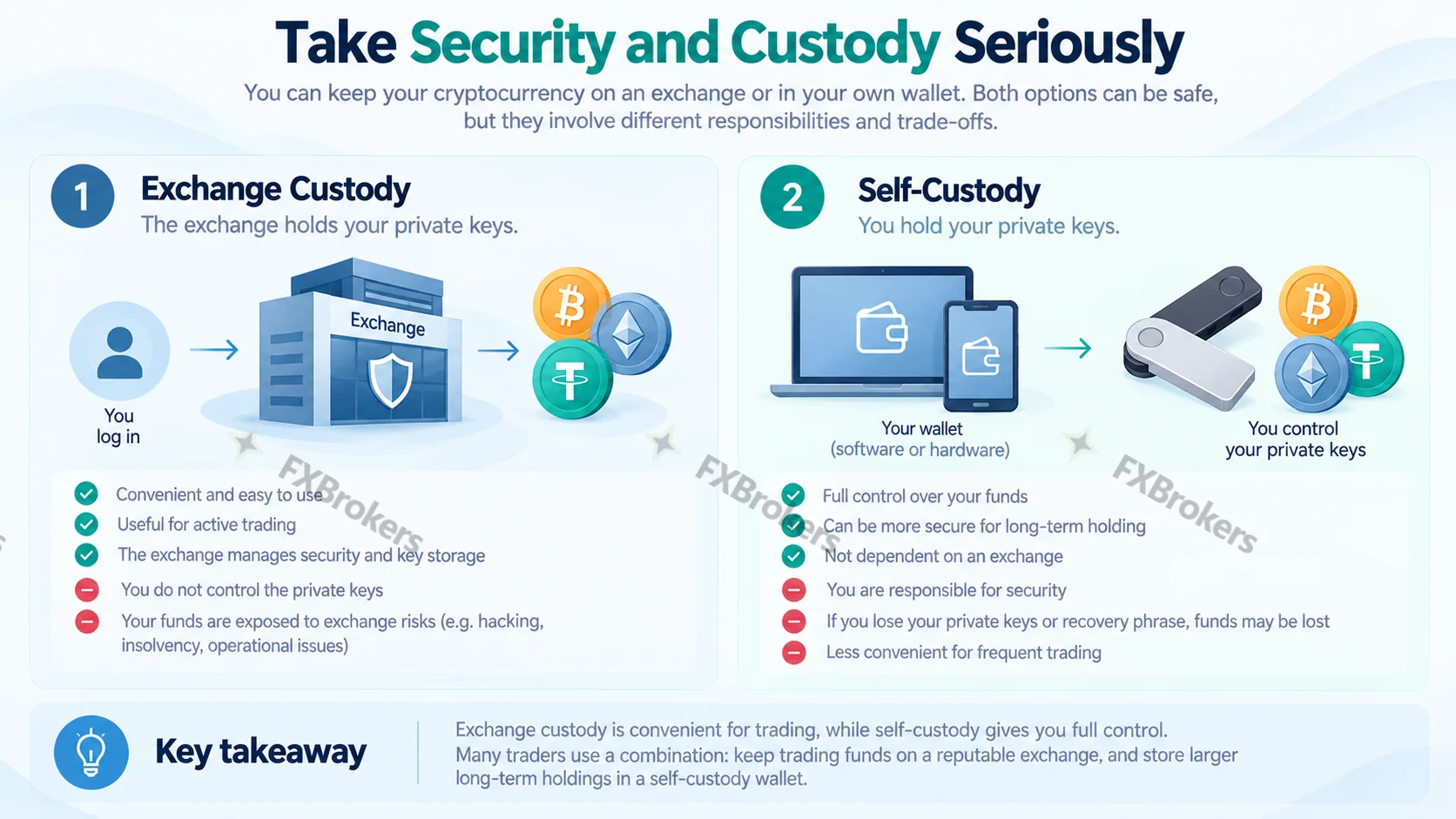
Exchange custody and self-custody involve different responsibilities. An exchange can suspend withdrawals or suffer operational problems, while a self-custody wallet can become permanently inaccessible if its recovery information is lost. Do not assume ordinary bank-deposit protections cover cryptocurrency holdings.
Common beginner mistakes
- Buying from hype: Social media popularity and testimonials are not reliable evidence of future returns.
- Ignoring the order preview: This can hide a wider spread, an unexpected fee, or the wrong product.
- Using leverage too early: Leverage increases exposure and can force liquidation during sharp price moves.
- Overtrading: Frequent buying and selling creates repeated costs and encourages impulsive decisions.
- Trusting guaranteed-profit claims: Promises of risk-free daily returns, secret signals, or deposits needed to unlock withdrawals are major warning signs.
- Using the wrong network or address: A transfer error may lead to irreversible loss.
- Failing to document trades: Missing transaction history makes it harder to understand performance and meet tax obligations.
When a message pressures you to act immediately, share access credentials, or move your crypto to a supposedly safer wallet, stop and verify the situation through an independent channel. Fraud prevention is part of trading competence, not an optional extra.
Is Cryptocurrency Trading Legal and Taxable?
Crypto trading rules depend on your location, the service provider, and the product. A platform being accessible online does not prove that every service it advertises is legally available to you. Registration or regulatory oversight may apply only to particular activities and does not automatically protect you against market losses.
United States
Exchange availability and permitted products can differ by state. Verify a platform's eligibility rules for your residence and the type of trade you intend to place. For US federal income tax purposes, digital assets are generally treated as property. Selling cryptocurrency for dollars or exchanging one digital asset for another can trigger a capital gain or loss when the asset is held for investment. Income from digital assets can be taxed differently. Keep purchase dates, cost basis, sale proceeds, fees, and records of each disposal. The applicable rules depend on your transactions and circumstances.
United Kingdom
Check that a provider is permitted to offer the specific service you want and understand the protections that apply. Direct cryptoasset purchases generally do not have the same protections as bank deposits, including Financial Services Compensation Scheme (FSCS) coverage. FCA rules continue to prohibit firms from selling cryptoasset derivatives to UK retail clients. Certain qualifying crypto exchange-traded notes (cETNs) became available to retail investors from 8 October 2025, but these investment products are different from ordinary spot trades.
Simply buying cryptoassets with pounds does not normally create a taxable disposal. Selling or swapping cryptoassets, using them to pay for goods, or certain gifts may give rise to Capital Gains Tax. For UK capital-gains calculations, acquiring the same type of token within 30 days after a disposal can activate special matching rules. Maintain transaction records in pounds sterling and check current HMRC guidance for your circumstances.
Important: Laws, exchange permissions, and tax rules can change. Confirm the requirements relevant to your country and circumstances before trading. This guide is educational information, not personalized financial, legal, or tax advice.
Before You Place Your First Trade
You are ready to consider a first spot trade when you can answer these questions without guessing:
- Am I using a platform and product available in my location?
- Do I understand what cryptocurrency I am buying and which currency I am paying?
- Is the account secured, and do I know how withdrawals work?
- What is the full cost to buy, sell, and potentially withdraw?
- How does my chosen order type execute, and what might prevent or change a fill?
- How much can I lose, and what is my plan if the market moves against me?
- Can I find the trade confirmation and export the records I may need later?
The bottom line: Learning how to trade cryptocurrency is not about finding a coin that promises quick profits. It is about understanding the market, controlling costs, protecting access to your assets, and making decisions you can explain before and after each trade. Start with the process, not the promise of a return.
FAQs
How do I start crypto trading as a complete beginner?
Learn spot trading first, practice with hypothetical orders, and compare exchanges available in your location. Secure your account, examine funding and trading fees, choose one trading pair, and place a small order only when you understand its price and risks. Check the completed trade and keep records.
Is $100 enough to start trading cryptocurrency?
It can be, provided the exchange permits a sufficiently small order and fees are manageable. If the platform charges fees on top of the order amount, your purchase must be smaller than $100 to stay within a $100 cash budget. Treat the money as a modest learning budget, not a reliable source of income; fees can erase gains from small price moves.
Can I start crypto trading with $1?
Some services allow very small fractional purchases, but minimum orders and fees vary. A $1 trade may be unavailable or uneconomic. Check the actual minimum and the full price shown in the order preview instead of assuming that every exchange uses the same threshold.
How much money do I need to start crypto trading?
There is no single minimum that suits everyone. You need enough to meet the platform's minimum order and fees, but you should never use money required for everyday expenses or emergency savings. Practicing with a trading journal costs nothing and is a sensible first step.
How can I teach myself crypto trading for free?
Study spot trading, trading pairs, bids and asks, order types, fees, and security. Then record simulated trades with entry reasons, exit plans, and hypothetical results. Review the mistakes in those records before using money. Free education is useful; paid signals and guaranteed-return courses are not prerequisites.
Can I make $100 or $1,000 a day trading cryptocurrency?
Daily trading gains are possible, but a fixed daily profit is not predictable or guaranteed. The capital, price movements, and risk needed to pursue such a target can be substantial. Some days bring losses, and transaction costs reduce gains. Beginners should prioritize learning and capital preservation over daily income targets.
Is spot crypto trading the same as day trading or investing?
No. Spot trading describes the type of transaction: buying or selling the underlying cryptoasset. Day trading describes how long a position is held, typically within one day. Investing usually describes a longer-term approach. A spot position can be day-traded or held for years.
What fees will I pay when I buy and sell crypto?
You may pay trading fees on both transactions, plus a spread, funding charges, conversion costs, or withdrawal and network fees. The actual amounts depend on the exchange, product, order execution, and payment method. Compare the entire buy-and-sell cost, not just the advertised trading commission.